An Organization Made up of Organizations


Let’s start with an uncomfortable truth:
Most nonprofit programs don’t fail because people don’t care. They fail because they were never designed to succeed.
.
And before we point fingers at the social sector, let’s be clear: businesses struggle with this, too. If you’ve ever watched “Shark Tank,” you’ve seen it play out in real time. Passionate founders. Big ideas. Slick pitches. And then the sharks ask the questions that actually matter:
-
Who is this really for?
-
What problem are you solving?
-
Why hasn’t this worked before?
-
How do you make money? (For nonprofits, how will you raise this money?)
-
What happens when you scale?
Most deals die right there. Not because the founders lack creativity, but because they skipped the discipline of upfront design.
The social sector is no different. We launch programs because the need is real, the idea feels right or funding becomes available. But too often, we skip the hard work of pressure-testing assumptions before we commit time, money and people.
The sector doesn’t need more new ideas. It needs better-designed ones. (And long-term capital to get the idea just right, but that is a topic for another blog!)
Why Lean Thinking Still Matters (and Why It Needs Translation)
The Lean Startup concept, popularized by Eric Ries, challenged entrepreneurs to stop perfecting plans on paper and start testing real assumptions in the real world. Instead of guessing what will work, you learn your way forward.
At its core, Lean Startup is a hypothesis-driven approach for finding a sustainable and scalable business model. It replaces lengthy business plans with three simple steps:
-
Build: Developing the business model
-
Measure: Eliciting customer feedback
-
Learn: Developing the product intentionally
(For a short breakdown of the model, check out my favorite explainer video.)
That logic still holds up beautifully today. But nonprofits are not startups chasing profit. They are mission-driven organizations accountable to communities, funders, boards and staff. So, the model needs to be adapted to reflect reality in the social sector.
That’s why, more than a decade ago, we began using a six-step, nonprofit-specific version, which is the best mash-up of Lean Startup, Market Research and Design Thinking, with our clients. We’ve refined it repeatedly, because continuous improvement (for us and clients) is the whole point. We also expanded it later in combination with our Social Alchemy framework, which provides a step-by-step process for taking an idea from innovation to scale.
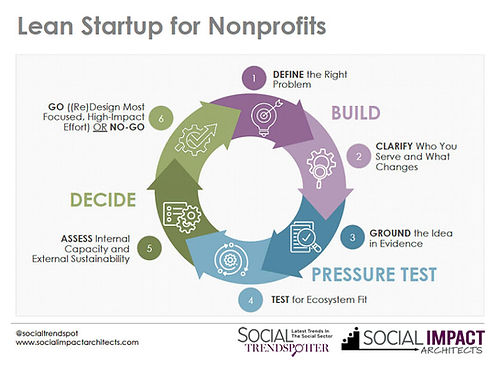
Step #1: Define the Right Problem
Most programs start with a solution. Passionate individuals see a need in the social sector and want to fill the void. That’s the first mistake.
Strong program design starts by slowing down and asking:
-
What problem are we trying to solve?
-
Why does it exist? Why does it persist?
-
Are we addressing root causes or just symptoms?
-
Why isn’t anybody else addressing it? If someone is addressing it, what isn’t working?
-
Do the people closest to the issue define the problem the same way we do?
Once you have answers to these key questions, you can then develop your overall hypothesis around the social solution, also known as a theory of change. Not as an academic exercise, but as a gut check on whether your idea matches reality.
Step #2: Clarify Who You Serve and What Changes
Once the problem is clear (I use the 80/20 rule here), discipline matters.
Be specific about:
-
Your target population
-
What success actually looks like
-
The outcomes you expect to see over time
-
How activities logically lead to impact
-
What is essential versus nice to have
A logic model (what I call your “secret recipe”) is one of the most useful tools at this stage. It’s not just because funders and donors like them, but because weak logic shows up fast when you’re forced to map it out.
If the story doesn’t make sense on paper, it won’t make sense in practice.
Step #3: Ground the Idea in Evidence
Before building something new, look around. While this begins in Step #1, clarity improves as the idea takes shape. With the advent of AI, this is easier than ever to accomplish!
Give ChatGPT the outline of your idea and ask:
-
What does existing research say about what works?
-
What promising or best practices already exist?
-
What has failed, and why? What can we learn without repeating someone else’s mistakes?
-
How does our idea compare against best practices? Be brutal.
-
Is anyone in our region doing something similar? Compare our idea to their program based on strengths and challenges. Are we duplicating their work? Be brutal.
Very few nonprofit ideas are truly original. That’s not a criticism. It’s an advantage if you’re willing to learn that everyone innovates using what I like to call “leapfrog innovation.” Every great idea came from learning from the past and building on what already exists.
Trust me: programs grounded in evidence are easier to fund, easier to defend and easier to improve.
Step #4: Test for Ecosystem Fit
No program operates in a vacuum. We should always use “upstream/downstream” thinking to understand how our clients are connecting to community resources.
At this stage, do an environment scan and look at:
-
Who else is working with the same population locally?
-
Where your work overlaps or complements existing efforts?
-
Whether partnership makes more sense than duplication?
-
What funding and policy realities shape the landscape?
At this point, you should also talk to community members, partners and funders. If there’s no appetite, no gap or no clear value-add, that’s important information. If the market isn’t promising, you might revise your idea and/or consider ways to partner with others on the unique aspects of your idea. As I often tell my students: “Fail early, fail cheaply!”
Step #5: Assess Internal Capacity and External Sustainability
Now that you know what it takes to be successful, conduct an internal review of your capacity to execute the idea as well as the community’s ability to sustain it. In your research, you have found what works, what is fundable and how you are different, so by now you understand your unique value proposition as well as a possible sustainable business model.
Ask the uncomfortable questions:
-
Is this aligned with our mission?
-
Do we have the staff, skills and leadership to do this well?
-
What will this pull focus from?
-
Is there a realistic path to sustainability?
This is where many good ideas should pause or stop entirely. However, if the idea has a market, but you are concerned about internal and external capacity, consider ways to partner or share your idea with others. Sometimes it is more practical and efficient to incubate an idea within an existing organization (as a social intrapreneur) than to start an idea and an organization at the same time.
Or, alternatively, you can pilot it to see if it is “sticky” and deserves future exploration.
Step #6: GO ((Re)Design Most Focused, High Impact Effort) OR NO-GO
By now, your idea has been pressure-tested. You can make an informed decision about whether to go forward and turn your idea into action by developing the most meaningful delivery of the program, service or policy effort for your community.
You have enough information to make a real decision:
-
GO: Design the most focused, high-impact version of the program and commit to continuous learning and improvement.
-
NO-GO: Archive the idea, share insights with others and redirect energy to higher-leverage work.
Both outcomes are wins if they are intentional.
Why This Works (for Nonprofits and Businesses Alike)
Lean Startup exists for one reason: uncertainty. Businesses use it to avoid wasting capital. Nonprofits should use it to avoid wasting trust, time and mission. The stakes are different, but the discipline is the same.
This custom six-step framework strengthens the classic Build–Measure–Learn cycle by adding:
-
Evidence before execution
-
Community and ecosystem awareness
-
Capacity and sustainability checks
-
Clear decision points, including the courage to stop
The result is fewer shiny initiatives, stronger impact and more confidence from funders, boards and communities.
We’d love to hear from you about your work in this area and how you approach program design before you write a grant or launch an initiative.